编辑:时间:2026-09-17 11:59:06 浏览次数:
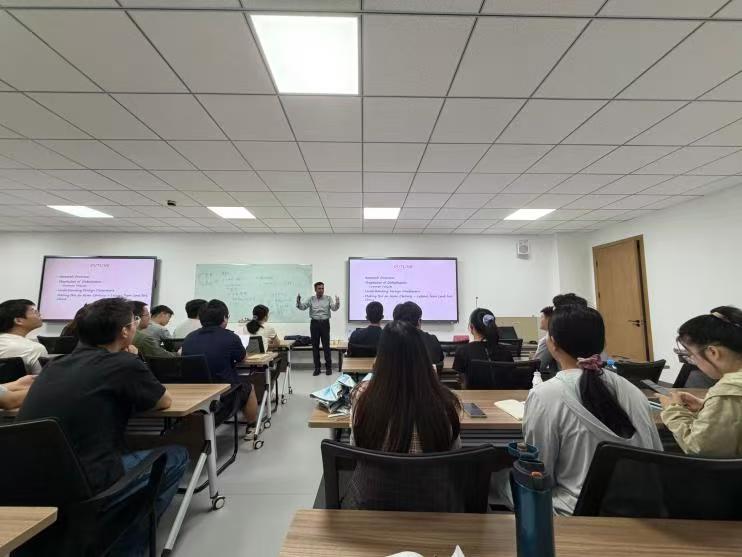
On the morning of September 15, the Institute of National Studies of Jiangxi University of Finance and Economics (JUFE) hosted an academic lecture themed “De-Internationalization, Decoupling and Foreign Divestments” in Room 427, Caishu Building, North Campus of Jiaoqiao.
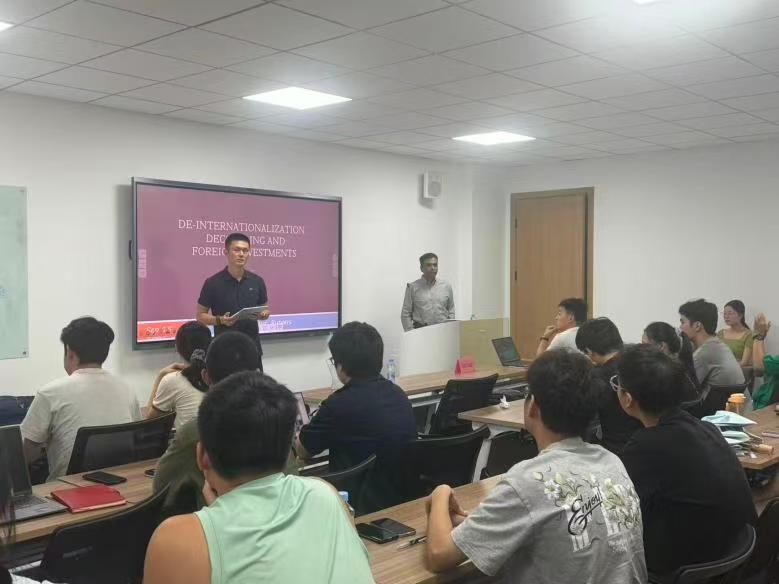
The lecture was moderated by Feng Lingbing, Vice Dean of the Institute of National Studies. The keynote speaker was Ajai Gaur, Distinguished Professor of Rutgers Business School and Chair of the Department of Management and Global Business. Faculty members and graduate students of relevant disciplines attended the lecture and engaged in active academic exchanges, creating a strong scholarly atmosphere.
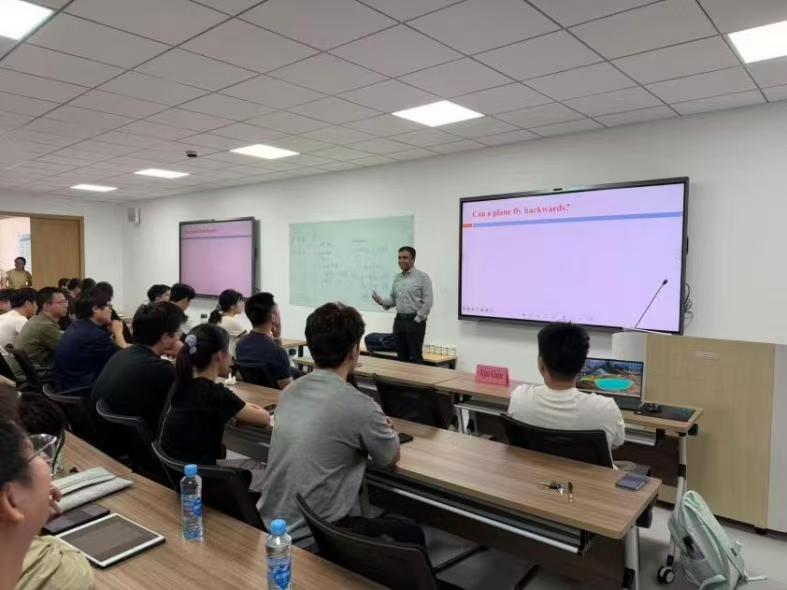
During the lecture, Professor Gaur began with an intriguing metaphorical question: if the headwind grows stronger, will an airplane fly backward? And how has this headwind — namely, the intensifying tide of anti-globalization — become increasingly powerful? The thought-provoking opener quickly drew the audience into the topic. He then systematically reviewed the research landscape on de-internationalization, decoupling, and foreign divestments. He pointed out that international business research has long focused on firms’ international expansion, while paying insufficient attention to de-internationalization and foreign divestments. Against the backdrop of intensifying geopolitical conflicts and the restructuring of global value chains, multinational enterprises (MNEs) divesting and restructuring their overseas assets to cope with challenges has become a new trend.
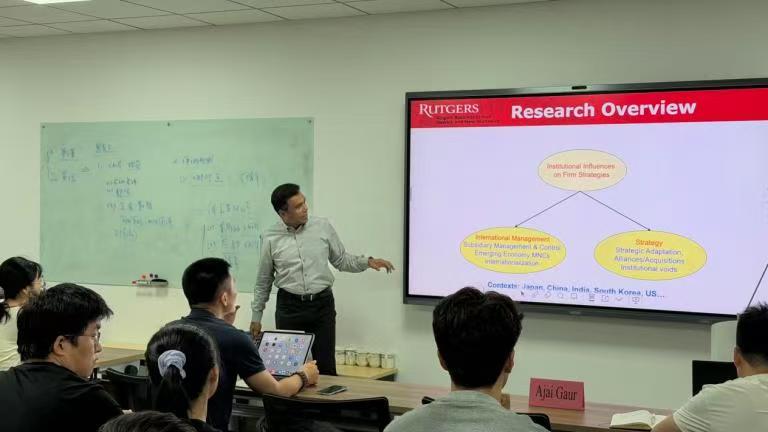
He then analyzed the logic underlying anti-globalization, arguing that Western skepticism toward globalization mainly stems from development inequality, identity differences, and loss of influence. Citing a 1944 publication, he noted that protectionism is by no means a new phenomenon. With regard to “manufacturing reshoring,” he refuted the claim that “bringing manufacturing jobs back to the United States will bring prosperity,” pointing out that the decline in manufacturing employment does not reflect a decline in output, but rather efficiency gains driven by automation and robotics. He further argued that the evolution of developed economies’ industrial structures from agriculture to manufacturing and then to services is an inevitable rule of economic development, and that forcibly reversing this process may reduce overall prosperity.
|
In the section on foreign divestments, Professor Gaur noted that the drivers of divestment include geopolitical pressures, home-country economic problems, and changes in host-country policies, while the main modes of divestment include outright sale, liquidation, and partial transfer of control. Taking TikTok’s equity restructuring as an example, he illustrated how firms can preserve future control through a partial reduction of equity stakes. He also emphasized that state-owned enterprises (SOEs) and private enterprises differ in their propensity to divest when confronted with political risks. Offering an optimistic outlook, he argued that despite the persistence of anti-globalization, Asia still has the potential to become the center of gravity of the global economy. He distilled the “One-Two-Three-Four-Five” framework embedded in China’s development planning, underscoring the principles of innovation, coordination, green development, openness, and sharing. He noted that the key to the “Asian Century” lies in overcoming internal trust deficits and geopolitical divergences and in deepening regional value chain cooperation.
Finally, Professor Gaur identified four new research questions worthy of further investigation: Who decides on divestment — the firm, the government, or firm–government interactions? From which countries do firms divest? In what manner do they divest — through liquidation, outright sale, or TikTok-style partial equity divestiture? And why do they divest — because of geopolitical pressures, home-country economic conditions, or policy changes? Since most of these questions remain empirically untested, they point to promising directions for future academic research.
The lecture was theoretically rigorous and intellectually frontier-oriented, offering new perspectives for interdisciplinary research at the intersection of international business, global strategy, and multinational enterprise governance.
(Text/ Li Yangjue, Zhou Ziwei, Luo Tianwei
Photography/ Zou Hongrui, Chen Deleng
Editor/Liao Yuqin Unit reviewers/Tan Yuhua, Zhang Hua, Guo Lu)