编辑:时间:2025-12-23 18:57:29 浏览次数:
On the afternoon of December 20th, the School of Statistics and Data Science successfully held an academic lecture titled Publish or Perish: Myths, Realities, and Strategies for Success in Room 414 of the North Complex Building at the Jiaoqiao Campus. Professor Min Du, a Tenured Professor of Finance at the Business School of Edinburgh Napier University, UK, was invited by our school to deliver this lecture. The event was chaired by Associate Professor Lingbing Feng, Deputy Director of the National Conditions Research Institute, and attended by over 50 faculty members and students.
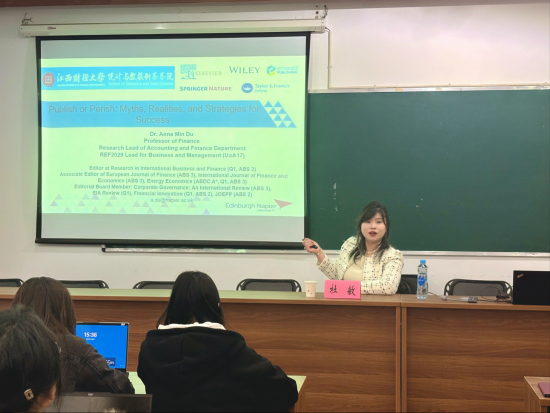
Professor Du commenced the lecture by delving into the iconic academic mantra Publish or Perish. Drawing upon her extensive experience as a journal editor, peer reviewer, and researcher, she provided an in-depth analysis of the core myths and the actual landscape within academic publishing. Addressing common perceptions such as academic evaluation prioritizing quantity over quality, high-impact journals determining academic fate, and rejection equating to failure, she utilized comprehensive data and representative case studies to offer critical insights. Professor Du highlighted the highly competitive reality in Economics and Finance, noting the low acceptance rates (as low as 5%) for top-tier journals (such as UTD24, FT50, ABS4), and emphasized that manuscript rejection is a normal part of the research process and a crucial opportunity for refining scholarly output.
Focusing on the core question of how to achieve sustainable publishing success, Professor Du systematically shared actionable strategies. She advocated for constructing research questions based on the criteria of theoretical generativity, practical relevance, and empirical feasibility, suggesting the development of a strategic research agenda by concentrating on core themes and expanding into related studies. She detailed key elements of structured academic writing, stressing that the introduction must clearly state the core contribution and research questions, while the analysis section should demonstrate analytical depth beyond merely presenting data. Regarding reviewer feedback, Professor Du advised providing precise responses to every comment, emphasizing that even rejected manuscripts should be revised and resubmitted, thereby leveraging the peer-review process to enhance paper quality. Furthermore, drawing from her experience as a guest editor for special issues in several SSCI Q1 journals like Energy Economics and having published over 90 SSCI Q1 papers, she shared insights on the significant role of interdisciplinary collaboration and methodological diversification in fostering academic innovation.
Using examples from Finance research, Professor Du further deconstructed the core strategies for sustainable publishing success. She proposed developing a problem-oriented rather than journal-oriented strategic research plan. This involves identifying research questions with theoretical generativity and practical relevance through two pathways: recognizing gaps in the literature and conducting phenomenon-driven inquiry, subsequently building a series of interconnected papers around a central theme rather than isolated studies. Professor Du placed particular emphasis on the importance of methodological diversity and systematic theory building. She outlined the necessity of establishing a resilient reject-revise-resubmit mechanism, viewing reviewer comments as a valuable channel for free expert consultation to improve manuscript quality. Additionally, she shared potential research directions in emerging fields like ESG disclosure and FinTech, along with practical techniques for addressing different types of reviewer comments.

During the Q&A session, attending faculty and students actively engaged by raising questions and sharing reflections closely related to the lecture topics, leading to in-depth discussions based on their own research and practical understanding. Professor Du Min addressed each query, providing targeted suggestions combined with specific cases. The interaction was dynamic, fostering a strong and vibrant academic atmosphere.
(By Wu Yuhang ,Ye Yanlin, Wu Yuhang,Lin Yang,Chen Xi,Tao Chunhai)