编辑:时间:2026-06-27 11:37:55 浏览次数:
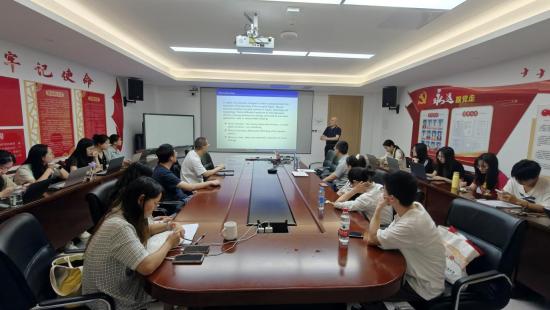
On the morning of June 23, the School of Statistics and Data Science held a special academic lecture in the Party Members' Activity Room (Room 406) at the Cai-Shu Building, North Zone of Jiaoqiao Garden.
Themed Strong well-posedness of the two-dimensional stochastic Navier-Stokes equation on moving domains, the lecture featured a frontier academic sharing by Professor Zhang Tusheng, a world-renowned probabilist from the University of Science and Technology of China (USTC). Relevant faculty members and postgraduate students from the school attended the event, fostering a vibrant atmosphere of academic discussion and research.
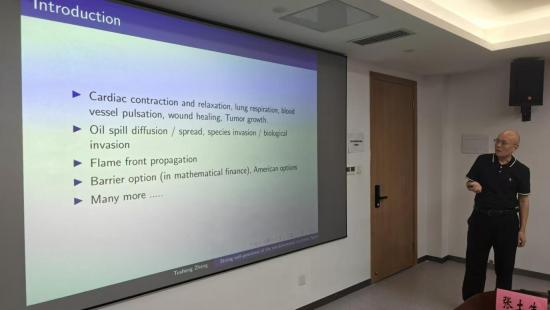
Professor Zhang Tusheng began his lecture by highlighting the practical applications and academic significance of the Navier-Stokes equations, providing a systematic overview of the long-term research landscape in this field both domestically and internationally. He explained that these equations serve as a core theoretical tool for characterizing various fluid motions, forming the mathematical underpinning for numerous industries, including weather forecasting, aircraft manufacturing, and energy exploration.
Professor Zhang then compared the research distinctions between models defined on fixed spatial domains and those on time-varying moving domains. He noted that for deterministic models without stochastic perturbations, classical analytical methods suffice to demonstrate the existence and uniqueness of solutions. However, he pointed out that once stochastic noise is introduced, traditional analytical tools become inadequate. When combined with a continuously evolving state space, this gives rise to numerous unresolved theoretical challenges.
Following this, Professor Zhang focused on his team's latest original research, fully elaborating on their complete proof of the strong well-posedness for two-dimensional fluid equations with multiplicative noise on moving domains. He stated that moving domains generate special nonlocal effects, making conventional global analysis approaches difficult to implement. To overcome this, his team innovatively adopted a piecewise variational research framework. This method involves dividing the entire time horizon into multiple independent short intervals, sequentially proving the unique existence of solutions within each single interval, and calculating the minimum reasonable length for these intervals. By piecing together the local solutions, the team ultimately established the complete conclusion of global well-posedness.
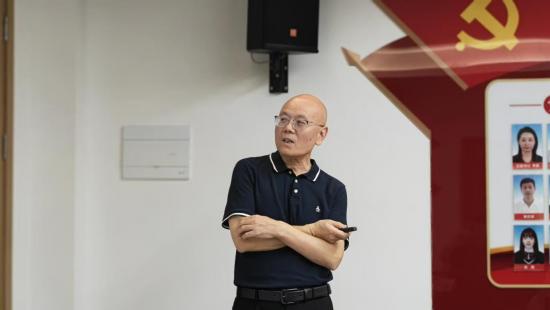
Professor Zhang Tusheng meticulously deconstructed the complete steps of the theoretical derivation, clearly elucidating the core methodological framework to the attending faculty and students.
The research first stipulates that all evolving domains are generated by volume-preserving smooth mappings. By leveraging coordinate transformations, the equations on moving domains are transposed onto a fixed reference domain, thereby resolving the complex constraints imposed by the continuous spatial evolution. Although this transformation significantly complicates the structure of the resulting equations, the team introduced truncated correction forms to streamline the analysis. They relied on a previously established general theory for stochastic partial differential equations to prove the existence of local solutions.
Subsequently, the team constructed specific test functions to derive uniform estimates, effectively eliminating the auxiliary conditions introduced by the truncation. Finally, by synthesizing the established lower bound on the length of short time intervals, the researchers extended the piecewise local solutions to a complete global solution. This process culminated in a closed-loop, self-consistent system of rigorous mathematical argumentation.
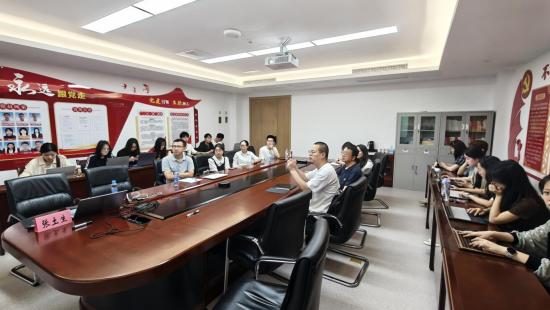
The lecture was characterized by theoretical rigor and a progressive logical structure, offering a novel research perspective to the school's researchers dedicated to the interdisciplinary fields of stochastic analysis, fluid statistics, and stochastic partial differential equations (SPDEs).
Attending faculty and students unanimously remarked that the report clearly outlined the core challenges and innovative resolution pathways of stochastic fluid models on moving domains. They noted that it significantly broadened their horizons in interdisciplinary research and holds significant guiding value for future endeavors in data-driven fluid statistics and stochastic modeling.
By: Bao Daobin
Photos by: Bao Daobin
Affiliation: School of Statistics and Data Science
Reviewed by: Tan Yuhua, Zhang Hua, Guo Lu
Contact: Bao Daobin | Tel: +86-185****0051