编辑:时间:2019-12-10 12:09:10 浏览次数:
On the afternoon of November 28, at the invitation of the College of Statistics of Jiangxi University of Finance and Economics, Professor Geng Zhi of Peking University gave an academic lecture entitled Cause and Effect Inference and Causal Network in the Conference Room 313 of School of Statistics. The lecture was hosted by Professor Shihua Luo, dean of the College of Statistics. Deputy Dean Weiying Ping and some teachers and graduate students listened to the lecture.
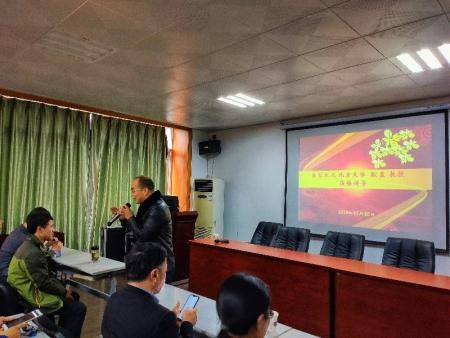
Professor Geng is a professor and doctoral supervisor of the School of Mathematical Sciences at Peking University, majoring in mathematical statistics and biomedical statistics. Research interests include causal inference, incomplete data analysis, biomedical and epidemiological methods.The research results are mainly published in core journals in the fields of statistics, machine learning and artificial intelligence.
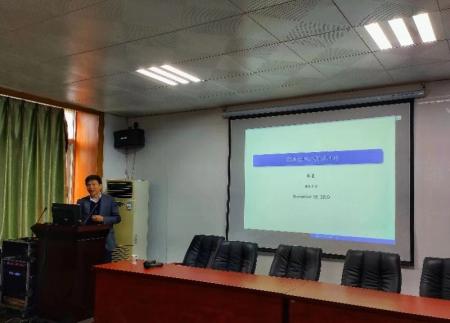
Starting from the development of human cognitive methods, Professor Geng talked about the foundation of the two great achievements of western scientific development-the logic system of situation and the causality discovered through systematic experiments. He introduced the description of causality at three levels: Correlation, Intervention, Counterfactual. It is pointed out that today's artificial intelligence is at the lowest level of causality. In terms of the research boom in artificial intelligence, Professor Geng has also conducted in-depth explorations. He believes that probabilistic methods that can cope with uncertainty in the fields of artificial intelligence, machine learning, and robotics may become mainstream. In the introduction to the Yule-Simple paradox and the surrogate index paradox, Professor Geng revealed the essential difference between the correlation coefficient and causality of the Yule-Simple paradox and the surrogate index paradox: whether to consider the existence of unknown confounding factors, for the individual logical reasoning cannot be applied to statistical conclusion reasoning, all kinds of conclusions from large data is difficult to become a knowledge of human reasoning.
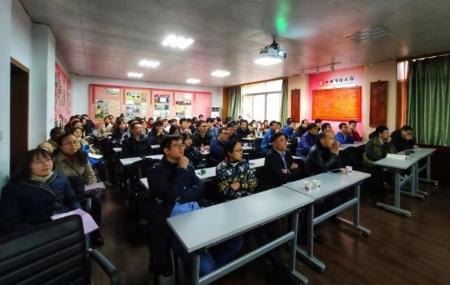
A question-and-answer session was set up at the end of the lecture, the students enthusiastically asked questions. Professor Geng answered these questions one by one based on his rich experience, and also shared some of his experiences in the research with the teachers present. This lecture broadened the scientific research horizons of the teachers and students and benefited everyone.